

The UiPath 2025 Agentic AI Report offers a comprehensive look into the evolving role of agentic AI in business automation. Drawing on the latest research and industry trends, the report highlights how AI-driven systems are transforming workflows, enhancing productivity, and enabling smarter decision-making.
Organizations are increasingly adopting agentic AI to handle complex tasks, reduce operational bottlenecks, and deliver more personalized customer experiences. This report provides actionable insights for leaders, technology teams, and decision-makers looking to leverage AI responsibly and effectively. From emerging opportunities to potential challenges, the findings reveal the strategies and innovations shaping the future of automation, helping businesses stay ahead in an increasingly AI-driven landscape.
Why Businesses Are Adopting Agentic AI
Modern businesses demand faster, smarter, and more flexible automation. UiPath’s 2025 survey highlights this trend: 93% of IT leaders express strong interest in agentic AI, while 90% report having processes that could benefit from it. Currently, 37% of companies are already leveraging agentic AI, and another 32% plan to invest within the next six months. These numbers underscore the growing importance of AI-driven automation in enhancing efficiency, reducing bottlenecks, and driving strategic growth across industries.
Read More: How AI is Revolutionizing Procurement and Sourcing
Key Benefits of Agentic AI for Businesses
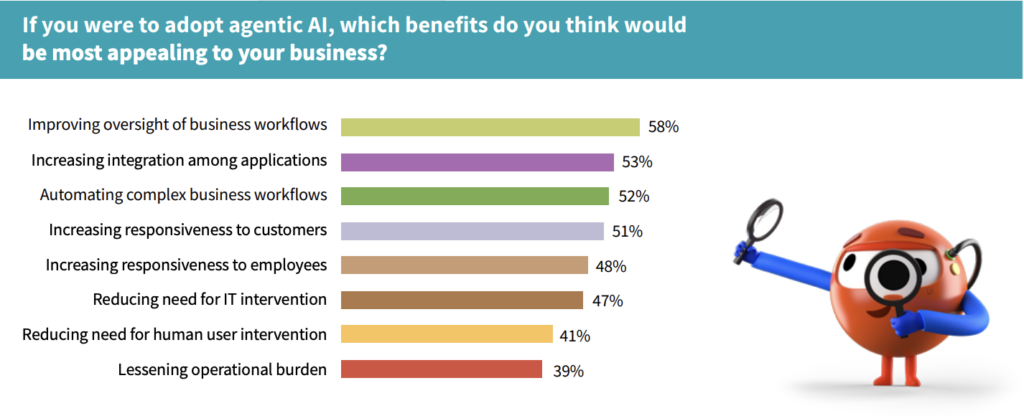
Companies implementing agentic AI experience significant advantages across operations. According to UiPath’s survey: 58% report improved workflow oversight, resulting in fewer errors and better decision-making; 53% highlight seamless integration, allowing AI to operate across all systems rather than in silos; and 52% emphasize its ability to automate complex tasks that traditional automation cannot handle. These benefits demonstrate how agentic AI not only enhances efficiency but also drives smarter, more connected, and scalable business processes.
Real-World Adoption: Fiserv’s Agentic AI Use Case
Leading fintech company Fiserv leverages agentic AI to automate merchant code assignments, cutting down manual work, minimizing errors, and accelerating operations. This practical implementation showcases how businesses can harness AI to streamline processes and boost efficiency. Learn more in the UiPath 2025 Agentic AI Report.
Challenges Slowing Agentic AI Adoption
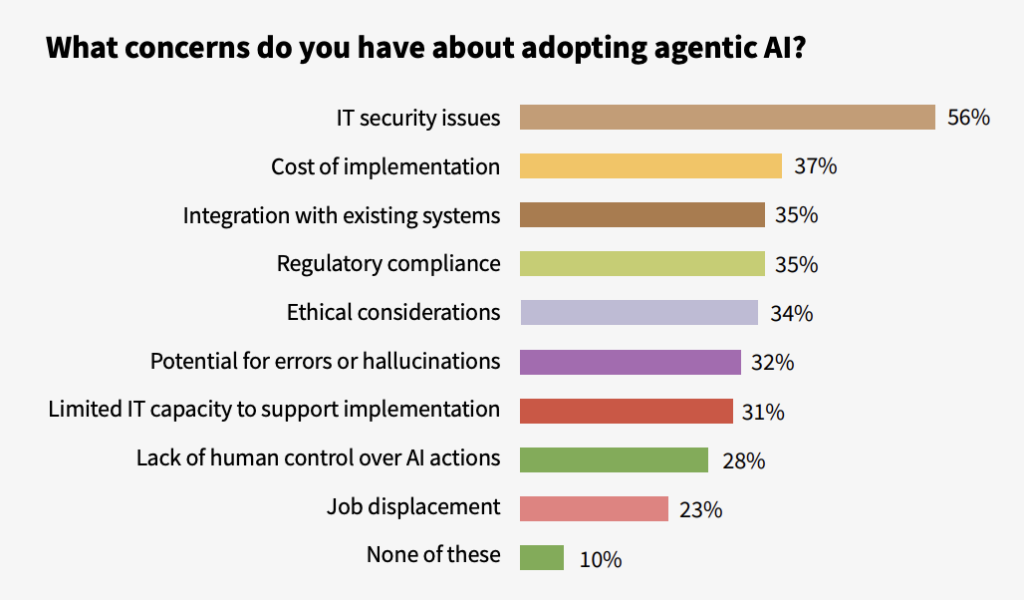
Despite its advantages, businesses face key concerns when adopting agentic AI. According to UiPath’s survey, 56% of organizations worry about security risks and safeguarding AI-driven processes, 37% are concerned about the cost and return on investment, and 35% struggle with integrating AI across multiple systems. Addressing these challenges is critical for companies aiming to implement agentic AI safely and effectively while maximizing its potential.
Overcoming Challenges in Agentic AI Adoption
Andy Fanning, an expert in regulated industries like healthcare, emphasizes that businesses can succeed with agentic AI by prioritizing trust, security, and phased adoption. “Trust in AI agents develops gradually, with safeguards to prevent unintended actions and oversight mechanisms. Tasks beyond the agent’s capability are delegated to humans,” he explains. Agentic AI complements rather than replaces human work. Success relies on strong governance, robust security, and careful integration planning. Organizations that implement AI through a structured, step-by-step approach are most likely to achieve efficiency, accuracy, and long-term operational benefits.
The Future of Agentic AI
The next wave of automation focuses on intelligence, not just efficiency. Agentic AI will connect AI agents, robots, and humans to create a coordinated, seamless workforce. Moving beyond isolated tools, it will adapt in real time to complex business needs. By reducing manual work and enhancing decision-making, agentic AI will provide organizations with a competitive edge in an increasingly dynamic business landscape.
Where Businesses Should Focus with Agentic AI
The greatest opportunities lie in leveraging AI agents to collect and analyze data across systems, automate decision-making with strong governance and security, and scale intelligent automation enterprise-wide. Organizations that integrate AI agents into workflows today position themselves to lead the next wave of automation, driving efficiency, accuracy, and competitive advantage.
Getting Started with Agentic AI
The future of automation is now, and businesses adopting agentic AI today will define tomorrow’s success. For a deeper look, download the UiPath 2025 Agentic AI Report to explore key insights and strategies. Ready to take action? Greenlight Consulting helps organizations transform AI-driven automation into measurable results let’s discuss how to get started.
Frequently Asked Questions
What is agentic AI?
Agentic AI refers to autonomous AI systems capable of making decisions, executing tasks, and collaborating with humans to optimize business processes.
How does it differ from traditional automation?
Unlike traditional automation that follows predefined rules, agentic AI can adapt, learn, and handle complex tasks in real time.
Which industries benefit most?
Finance, healthcare, manufacturing, and retail are early adopters, though any sector with complex workflows can benefit.
Is agentic AI safe to use?
With proper governance, security measures, and phased adoption, agentic AI can be deployed safely.
What are the main benefits?
Improved efficiency, reduced errors, seamless system integration, and the ability to automate complex tasks.
What challenges should businesses expect?
Security concerns, integration complexity, and initial costs are the main barriers.
How can businesses get started?
Begin with a structured approach identify key workflows, implement AI incrementally, and ensure oversight and governance.
Conclusion
Agentic AI is transforming the future of business automation by combining intelligence, adaptability, and human collaboration. Organizations that embrace AI agents today can streamline workflows, reduce errors, and make smarter, faster decisions. While challenges such as security, integration, and cost exist, a structured, phased approach with strong governance ensures successful adoption.
