
Artificial Intelligence (AI) is rapidly transforming procurement and sourcing, enabling organizations to operate smarter, faster, and more efficiently. By automating repetitive tasks, analyzing vast amounts of supplier data, and predicting market trends, AI empowers procurement teams to make informed decisions with greater accuracy. This technology streamlines supplier selection, risk management, and cost optimization while enhancing overall supply chain visibility.
Companies leveraging AI gain a competitive edge by reducing manual workloads, minimizing errors, and uncovering opportunities that were previously hidden in complex data. As AI continues to evolve, it is reshaping procurement strategies, driving innovation, and setting a new standard for efficiency and effectiveness in sourcing operations worldwide.
Understanding AI in Sourcing and Procurement
AI in sourcing and procurement leverages artificial intelligence to streamline supplier selection, contract management, and spend analysis. By utilizing predictive analytics, real-time insights, and automated workflows, AI enables smarter decision-making, reduces operational costs, and mitigates risks.
This technology improves efficiency across the procurement process, helping businesses identify opportunities, optimize supplier performance, and enhance overall supply chain management. As a result, organizations can achieve faster, data-driven decisions while maintaining agility and competitiveness in a dynamic market.
Read More: How Nvidia’s Latest AI Innovations Are Shaping the Tech Industry
The Role of AI in Sourcing
AI is transforming sourcing by making procurement smarter, faster, and more cost-effective. By analyzing large datasets, predicting market trends, and automating repetitive tasks, AI helps businesses optimize supplier selection, streamline contract management, and enhance negotiation strategies. It reduces errors, eliminates inefficiencies, and drives data-informed decision-making.
- Automated Supplier Selection: AI evaluates supplier data, past performance, pricing trends, and market conditions to recommend the best vendors. Automating supplier assessment saves time, ensures compliance, and improves sourcing decisions based on reliability and cost efficiency.
- Predictive Analytics for Cost Optimization: AI forecasts price changes using historical data, economic indicators, and supply chain trends. Procurement teams can make strategic purchases, negotiate favorable contracts, and reduce expenses, maximizing cost savings.
- Contract and Compliance Management: AI-powered tools review contracts, flag risks, and ensure legal compliance. Automation accelerates approvals, minimizes legal exposure, and prevents procurement delays, strengthening supplier relationships.
- Real-Time Market Intelligence: AI continuously monitors market data, supplier performance, and global pricing trends. Real-time insights allow teams to respond to disruptions, seize sourcing opportunities, and stay ahead of competitors.
- Fraud Detection and Risk Mitigation: AI identifies anomalies like overbilling, duplicate invoices, and unauthorized purchases, enhancing financial security and internal controls while minimizing procurement risks.
- AI-Driven Negotiation Tools: AI analyzes supplier data, historical deals, and industry benchmarks to recommend optimal pricing and contract terms. These tools improve vendor agreements, cost-effectiveness, and supplier relationships, giving businesses a competitive advantage.
AI is no longer just a tool it is a strategic enabler. By leveraging AI-driven insights, procurement teams can move from reactive decision-making to proactive, strategic planning, driving efficiency, cost savings, and long-term success in sourcing and supplier management.
Applications of AI in Sourcing
AI is transforming sourcing by automating complex tasks, strengthening supplier relationships, and optimizing procurement strategies. From demand forecasting to risk assessment, AI enhances efficiency, accuracy, and strategic decision-making across the procurement process.
- Demand Forecasting and Inventory Optimization: AI analyzes historical purchasing data, market trends, and economic indicators to predict future demand. This helps businesses maintain optimal inventory levels, prevent stockouts, and reduce excess spending.
- AI-Powered Supplier Evaluation: AI evaluates suppliers based on performance, contract history, pricing trends, and risk factors. This ensures the selection of high-value vendors while minimizing compliance risks and procurement inefficiencies.
- Automated Procurement Workflows: By automating purchase requisitions, approvals, and order processing, AI reduces manual effort, speeds up sourcing operations, and improves overall efficiency.
- Intelligent Spend Analysis: AI categorizes expenses, highlights cost-saving opportunities, and detects maverick spending. Real-time insights help procurement teams optimize budgets and enhance financial transparency.
- Chatbots and AI Assistants: AI-powered virtual assistants manage supplier queries, track orders, and automate approvals, improving response times and ensuring seamless communication.
- Sustainable Sourcing: AI identifies eco-friendly suppliers, evaluates sustainability metrics, and recommends greener procurement strategies, aligning sourcing practices with ESG goals while maintaining cost-effectiveness.
Integrating AI into sourcing improves accuracy, boosts cost savings, and reduces supply chain risks. Today, AI is essential for modern, competitive procurement strategies.
Implementing AI in Your Sourcing Strategy
AI can revolutionize procurement, but successful implementation requires a structured approach. Companies must strategically integrate AI tools to enhance efficiency, reduce costs, and improve supplier management without disrupting existing processes.
Assess Procurement Needs
Analyze procurement challenges to identify inefficiencies in supplier selection, contract management, or spend analysis. Understanding pain points helps select the most effective AI solutions.
Choose the Right AI Tools
Pick AI solutions that align with your objectives, such as spend analytics, automated supplier management, or predictive demand forecasting. Ensure the tools integrate seamlessly with existing systems.
Ensure Data Accuracy and Integration
AI depends on clean, centralized data. Integrating AI with ERP or procurement software ensures accurate insights and actionable recommendations.
Train Procurement Teams
Equip teams to use AI tools effectively through training on automation, data interpretation, and AI-driven decision-making.
Start Small and Scale Gradually
Pilot AI in areas like supplier evaluation or spend analysis. Refine processes based on results before expanding adoption across sourcing operations.
Monitor and Optimize Performance
Continuously track AI’s impact on efficiency, cost savings, and supplier management. Use insights to improve models and sourcing decisions over time.
By implementing AI strategically, businesses can achieve smarter, data-driven procurement, optimize costs, and strengthen supplier relationships. AI in sourcing is not just automation it’s a catalyst for informed, proactive decision-making.
Benefits of AI in Sourcing
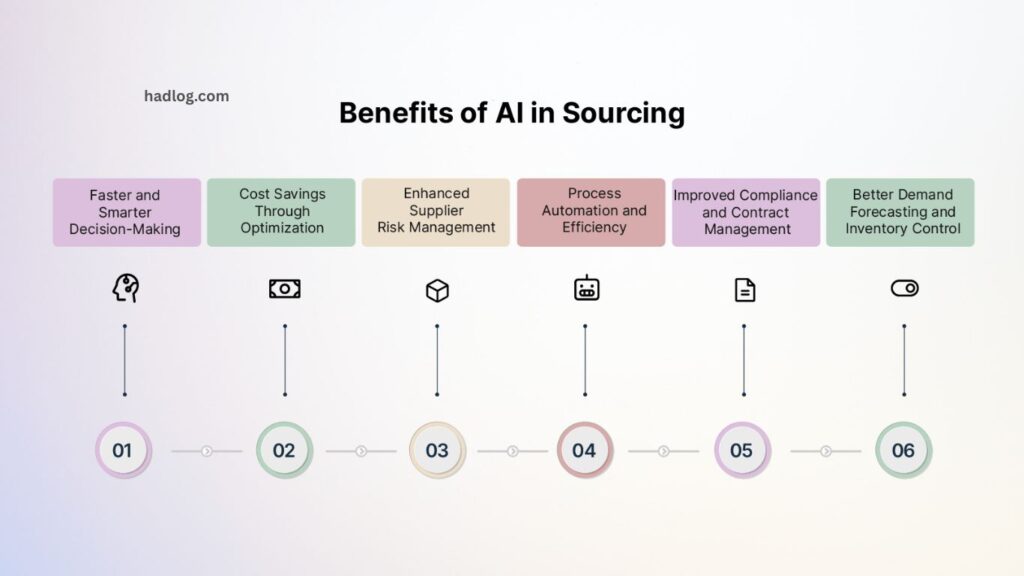
AI is transforming sourcing by improving efficiency, cutting costs, and enhancing supplier management. Procurement teams can leverage AI to automate routine tasks, make data-driven decisions, and manage risks proactively.
Faster, Smarter Decision-Making
AI analyzes large volumes of procurement data in real time, helping teams identify the best suppliers, negotiate favorable contracts, and optimize purchasing strategies for better outcomes.
Enhanced Supplier Risk Management
By evaluating financial stability, compliance records, and past performance, AI enables proactive risk mitigation, preventing supply chain disruptions and reducing exposure to unreliable vendors.
Process Automation and Efficiency
AI automates tasks such as purchase approvals, invoice matching, and supplier communication. This minimizes errors, accelerates procurement cycles, and frees teams to focus on strategic initiatives.
Improved Compliance and Contract Management
AI monitors contracts for risky clauses, regulatory changes, and renewal deadlines, reducing legal risks and strengthening governance in sourcing operations.
Better Demand Forecasting and Inventory Control
AI predicts future demand using historical data and market trends, optimizing inventory levels, preventing stockouts or overstocking, and improving cash flow management.
Cost Savings Through Optimization
AI identifies redundant expenses, recommends better supplier contracts, and optimizes order quantities, driving significant procurement cost reductions and financial efficiency.
AI in sourcing is more than a technological upgrade it’s a competitive advantage. Organizations adopting AI gain improved efficiency, lower costs, and stronger supplier collaboration, positioning themselves for long-term procurement success.
The Future of AI in Sourcing
AI is continuously transforming sourcing, bringing smarter, more predictive, and automated solutions to procurement. As technology evolves, procurement teams will benefit from increased efficiency, better decision-making, and significant cost savings.
Key Trends Shaping the Future of AI in Sourcing:
AI-Powered Autonomous Procurement
AI will move beyond simple automation to handle full procurement cycles—analyzing requirements, selecting suppliers, negotiating contracts, and initiating purchases allowing teams to focus on strategic priorities.
Blockchain-Integrated Smart Contracts
Combining AI with blockchain will create self-executing contracts that automatically enforce terms, validate compliance, and facilitate secure, transparent transactions, reducing disputes and accelerating contract execution.
Hyper-Personalized Supplier Relationships
AI analytics will enable tailored supplier interactions based on performance, pricing trends, and contract history, optimizing sourcing decisions for better pricing and long-term partnerships.
Ethical and Sustainable Sourcing
AI will help assess supplier ESG credentials, including environmental impact and labor practices, promoting responsible sourcing and ensuring compliance with global regulations.
The future of sourcing relies on self-learning AI systems that enhance transparency, efficiency, and sustainability, giving businesses a competitive edge in procurement operations.
How Spendflo Revolutionizes AI-Driven Procurement
Spendflo integrates AI-driven insights into procurement workflows, helping businesses optimize sourcing, reduce costs, and ensure compliance.
- AI-Powered Spend Analysis: Identify cost-saving opportunities, track spending patterns, and optimize budgets.
- Automated Supplier Negotiations: Use AI benchmarks to secure optimal pricing and contract terms.
- Contract Management and Compliance: Automate tracking, renewals, and compliance checks to reduce legal risks.
- Centralized Procurement Dashboard: Gain full visibility into sourcing operations for faster, data-driven decisions.
- Seamless ERP and SaaS Integration: Integrates with existing tools to streamline AI adoption without disrupting workflows.
By combining AI and automation, Spendflo simplifies procurement, strengthens supplier relationships, and drives substantial cost savings.
Frequently Asked Questions
What is AI in sourcing and procurement?
AI in sourcing uses artificial intelligence to automate supplier selection, contract management, spend analysis, and other procurement tasks, enabling smarter, faster, and data-driven decision-making.
How does AI improve supplier selection?
AI evaluates suppliers based on performance metrics, pricing trends, compliance, and past contracts, helping businesses choose reliable vendors and reduce procurement risks.
Can AI reduce procurement costs?
Yes. AI identifies cost-saving opportunities through spend analysis, predictive demand forecasting, and optimized supplier negotiations, leading to significant procurement savings.
How does AI help with risk management?
AI monitors supplier financial stability, compliance, and operational performance, allowing procurement teams to anticipate risks, avoid disruptions, and maintain supply chain resilience.
What tasks can AI automate in procurement?
AI can automate purchase orders, invoice matching, supplier communication, contract reviews, approvals, and data analysis, reducing manual work and errors.
Is AI suitable for small and medium-sized businesses (SMBs)?
Absolutely. AI solutions are scalable, allowing SMBs to optimize procurement processes, improve efficiency, and make data-driven sourcing decisions without large IT overhead.
What is the future of AI in sourcing?
The future includes autonomous procurement, AI-driven smart contracts with blockchain, hyper-personalized supplier relationships, and sustainable sourcing practices all enhancing efficiency, transparency, and competitiveness.
Conclusion
AI is transforming sourcing and procurement, empowering businesses to make smarter, faster, and more data-driven decisions. From automating repetitive tasks to optimizing supplier selection, managing contracts, and forecasting demand, AI enhances efficiency, reduces costs, and mitigates risks. The technology also supports sustainable and ethical sourcing while strengthening supplier relationships.
