
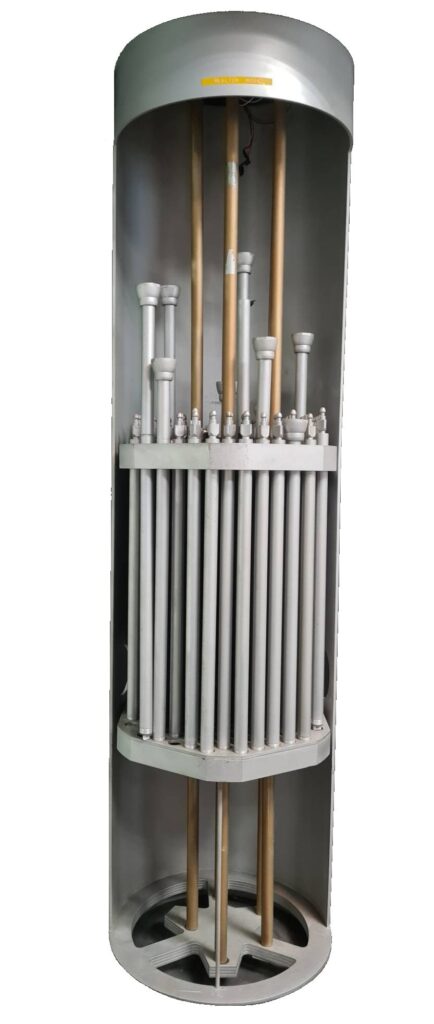
The future of an elegant reactor design may be decided by rust. Thorizon and TNO have launched a research programme into molten salt corrosion, testing the materials their PIONEER demonstrator will depend on. hadlog.com explains why a chemistry problem sits at the centre of advanced nuclear’s ambitions.
The Reactor Idea That Eats Its Own Plumbing
Molten salt reactors hold an honoured place in nuclear engineering: inherently elegant designs in which the fuel is dissolved in hot liquid salt, offering passive safety features engineers have admired since the 1960s. Their nemesis is equally simple. The salt that makes the design brilliant is ferociously corrosive, and it spends decades trying to dissolve the reactor meant to contain it. Thorizon and TNO have now launched a dedicated research programme into molten salt corrosion, testing materials to support Thorizon’s PIONEER reactor demonstrator.
The programme’s premise is that the molten salt reactor’s future will be decided less by neutron physics than by metallurgy. If alloys and coatings can be proven to survive the salt for a reactor’s working life, the design’s safety case becomes far easier to license. If they cannot, the concept remains a beautiful prototype technology, admired and unbuilt.
What the Thorizon and TNO Programme Will Test
The research, run with the applied-science depth of TNO’s energy research programmes, will expose candidate materials to molten salt under realistic conditions and measure exactly how corrosion proceeds: which elements the salt leaches first, how cracks initiate, and how flow, temperature and impurities change the attack. Salt chemistry control, the operator’s main defence, will be tested alongside the metals themselves.
That pairing matters, because corrosion in these systems is a system property, not a material property alone. The same alloy can survive in carefully purified salt and fail quickly in contaminated salt, which means a credible demonstrator needs both the right metal and a proven chemistry regime, monitored continuously. The programme is designed to deliver that combined evidence base for PIONEER.
Reading the Wider Picture
The programme’s data will matter beyond one company’s demonstrator. Corrosion results in molten salt systems are a shared scientific currency: regulators, rival developers and academics all build on published exposure data. By generating defensible, long-duration evidence, Thorizon and TNO are effectively raising the credibility of the entire molten salt field, including competitors who will cite the same literature. Readers can follow continuing coverage on hadlog.com as this story develops.
Why PIONEER Needs This Evidence
PIONEER is Thorizon’s planned demonstrator, the step between laboratory loops and a commercial plant. Demonstrators exist to retire risk in front of regulators, and the International Atomic Energy Agency’s work on molten salt reactors underlines materials qualification as the field’s shared bottleneck. Every serious developer in the sector faces the same questions from licensing bodies, and all of them need long-duration, defensible corrosion data.
Timescales are the brutal part. A reactor vessel must be trusted for decades, yet no programme can test for decades before building. Researchers therefore combine long exposures with accelerated testing and mechanistic modelling, arguing from how corrosion works, not merely how long a sample lasted. Building that argument convincingly is precisely the work Thorizon and TNO have set themselves.
A Wider Race in Advanced Nuclear
The programme arrives amid a broad revival of advanced reactor designs, driven by demand for firm, carbon-free power for industry and data centres, and by energy-security politics across Europe. Molten salt designs compete with high-temperature gas and fast reactors for that future, and materials readiness is one of the few contests among them that can be won in a laboratory before it is won in a market.
There is also a supply-chain dimension. Alloys rich in the elements corrosion resistance demands must be sourceable at industrial scale, and welds, pumps and heat exchangers each present their own salt-facing surfaces. A programme that qualifies a heroic alloy nobody can manufacture in quantity solves the wrong problem, so practical workability sits alongside corrosion numbers in the testing matrix.
What Comes Next
Expect a steady output of published corrosion data, down-selected materials and refined salt-chemistry protocols feeding directly into PIONEER’s design and licensing dialogue. For a field sometimes accused of promising reactors that are always fifteen years away, such unglamorous empirical progress is exactly the right kind of news: it is how fifteen years becomes ten.
Whether molten salt reactors ultimately win a large share of new nuclear build is a question of economics and politics still to be settled. But their technical case begins, unavoidably, with a metal’s ability to hold hot salt and hold it for a generation. Thorizon and TNO have now put that question at the centre of a serious programme, which is where it always belonged.
Background and Expert Reaction
The corrosion programme speaks to a lesson the nuclear industry has learned repeatedly: demonstration projects fail on materials more often than on concepts. Reactor physics can be calculated with confidence before a single component is built, but the behaviour of alloys in aggressive coolants over years of service can only be earned experimentally, one exposure test at a time. Programmes that respect that reality early tend to be the ones still standing a decade later.
European energy researchers also note the programme’s timing. With several advanced reactor developers competing for the same regulators’ attention, the teams that arrive with published, peer-scrutinised materials data will move through licensing conversations faster than those asking for trust. In that sense the Thorizon and TNO work is competitive strategy conducted by laboratory means, and its results will be read as closely in rival design offices as in Juelich or Petten.
Advanced nuclear will be built, if it is built, on evidence like this: unglamorous, quantitative and earned over years. The salt, at least, is now being asked the right questions.
