
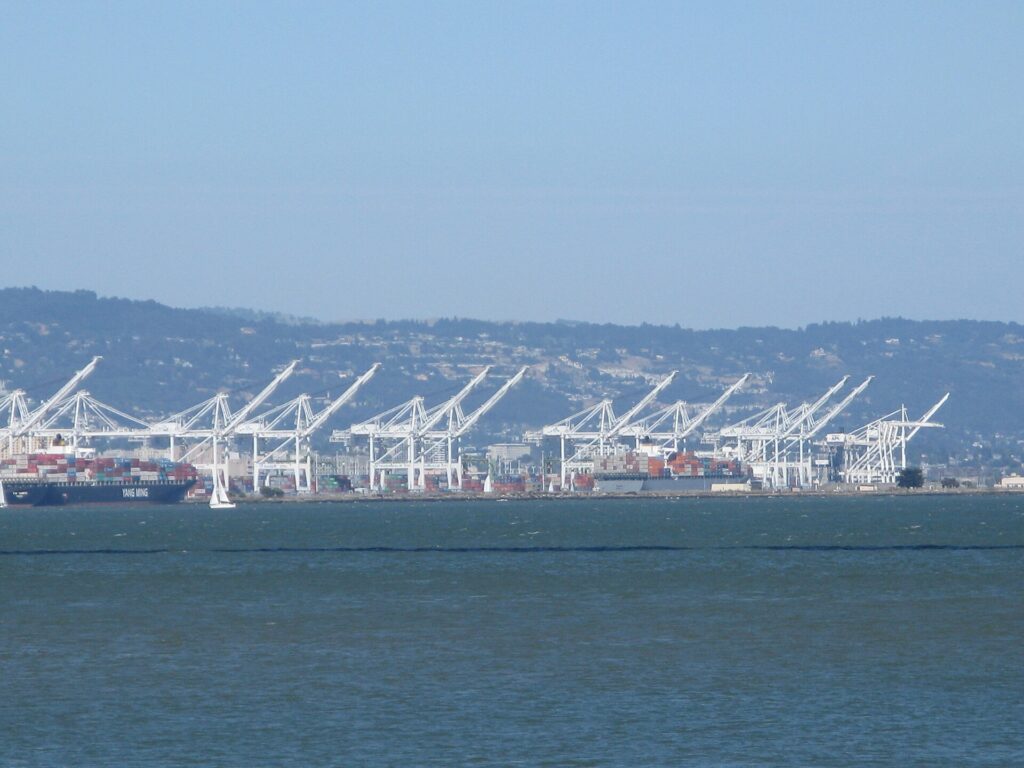
A container port is a machine for moving boxes, and like any machine it wastes energy where it waits, idles and hurries. Ships burn fuel at anchor awaiting a berth. Diesel cranes and trucks crawl around terminals in stop-start patterns planned around human shifts. Refrigerated containers draw power for days. Port authorities have traditionally cared about throughput; increasingly they are measured on emissions too, and automation, driverless vehicles, remote-operated cranes and software that orchestrates the whole terminal, turns out to cut both the queue and the carbon. The world’s busiest ports are now competing on how cleanly, as well as how quickly, they can turn a ship around.
Start with the ship, the largest emitter in the picture. A vessel waiting at anchor or slow-steaming in a queue burns fuel purely because the port was not ready for it. Systems that share arrival data between shipping lines and terminals, studied in logistics research by the World Bank, allow a ship to time its approach precisely and berth on arrival, a practice called just-in-time arrival. The savings are disproportionate: slowing a large vessel even slightly for the final leg can cut the fuel for that leg dramatically. Readers of our transport coverage will recognise the pattern from aviation and trucking, where the cheapest emission to eliminate is the one spent going nowhere.
Where Port Emissions Actually Come From
On the quay itself, the change is visible. The newest terminals run fleets of automated stacking cranes and driverless carriers that shuttle containers between ship and yard on electric power, following routes optimised to the metre. Because the machines are electric and centrally coordinated, they do not idle, race or take the long way round. Crane operators increasingly work remotely from office-style consoles, sometimes controlling equipment in a port on another continent’s time zone. Software, the least photogenic part of the system, does much of the saving: it sequences every lift so containers are handled once rather than shuffled repeatedly around the yard.
Cold ironing completes the picture. Ships in port traditionally keep engines or generators running to power lights, pumps and refrigeration, producing a steady plume of emissions beside, often, a city. Shore power lets a berthed vessel plug into the local grid and switch off, and it is spreading through major ports under regulatory pressure, particularly in Europe and California. Combined with automated mooring and faster turnarounds, it attacks the least efficient hours of a ship’s life, the ones spent stationary.
The Machines Taking Over the Quay
The human politics are unavoidable, and honest accounts include them. Automated terminals need fewer dockworkers per container, though they employ technicians, remote operators and software specialists in new proportions, and the transition has been fought over in ports from Los Angeles to Rotterdam. Unions argue, with some justice, that productivity gains should be shared and that automation imposed without agreement corrodes the workforce a port depends on in a crisis. The emissions argument has become part of this negotiation, deployed by both sides.
There is also a resilience question that efficiency metrics hide. A highly automated port is a software system, and software systems have failure modes that diesel and muscle did not: cyberattack, sensor faults in bad weather, a single corrupted update idling a terminal. Ports have suffered real outages, and the industry’s quieter conversation concerns backups, manual fallbacks and the wisdom of full automation versus assisted automation.
Efficiency, Jobs and the Politics of Automation
Even with those caveats, the direction is set, because the economics and the regulation point the same way. Shipping faces tightening emissions rules, carbon pricing is reaching maritime fuel in major markets, and cargo owners increasingly ask ports and lines for emissions data per container. Ports that invested early now market their lower emissions per box alongside their speed, and shipping lines, choosing where to call, are beginning to reward them for it.
The container port will never be picturesque, but it is becoming one of the clearest demonstrations that decarbonisation is often a story of coordination rather than invention. The cranes, carriers and cables matter less than the timetable that binds them: a ship arriving exactly when the berth, the cranes and the trucks are ready. Follow developments in the Gadgets section as more terminals make the switch, and as the definition of a well-run port quietly changes from the fastest to the cleanest as well.
